Testing FrontEnd
Ahora vamos a hablar de Vitest y React Testing library. Vitest es una librería open source escrita en JavaScript, muy optimizada para apliaciones basadas en Vite que permite implementar tests unitarios y junto a react-testing-library, escribir test de integración en nuestro proyecto.
Ambas librerías vienen instaladas por defecto en nuestro proyecto, ya que lo creamos con la toolchain vite. Ahora bien, si fuese necesario incluirlo, solo habría que ejecutar los siguientes comandos:
npm install --save-dev vitestnpm install --save-dev jsdom @testing-library/react @testing-library/jest-domnpm install --save-dev playwright @playwright/test
Ahora hay que añadir un comando para habilitar el testing:
  "scripts": {
    "dev": "vite",
    "build": "tsc && vite build",
    "preview": "vite preview",
    "test": "vitest",
    "test:e2e": "playwright test ./src/__tests__/e2e",
    "coverage": "vitest run --coverage",
    "lint": "eslint src",
    "lint:fix": "eslint src --fix",
    "storybook": "storybook dev -p 6006",
    "build-storybook": "storybook build"
  },
Después de esto tendremos que adaptar el fichero vite.config.ts para habilitar el testing:
/// <reference types="vitest" />
import { defineConfig } from 'vite';
import type { UserConfig as VitestUserConfigInterface } from 'vitest/config';
import react from '@vitejs/plugin-react'

const vitestConfig: VitestUserConfigInterface = {
  test: {
    deps: {
      inline: [/@just-web/, /just-web-react/]
    },
    setupFiles: ['src/setupTest.ts'],
    environment: 'jsdom',
  }
};

// https://vitejs.dev/config/
export default defineConfig({
  test: vitestConfig.test,
  plugins: [react()],
  server: {
    proxy: {
      // string shorthand: http://localhost:5173/auth -> http://localhost:4000/auth
      '/auth': 'http://localhost:4000',
      // string shorthand: http://localhost:5173/v1 -> http://localhost:4000/v1
      '/v1': 'http://localhost:4000',
    },
  },
});
Y añadir el fichero setupTest.ts dentro de la carpeta src para configurar react testing library con vitest:
// eslint-disable-next-line import/no-extraneous-dependencies
import { expect, afterEach } from "vitest";
// eslint-disable-next-line import/no-extraneous-dependencies
import { cleanup } from "@testing-library/react";
// eslint-disable-next-line import/no-extraneous-dependencies
import matchers from "@testing-library/jest-dom/matchers";

// extends Vitest's expect method with methods from react-testing-library
expect.extend(matchers);

// runs a cleanup after each test case (e.g. clearing jsdom)
afterEach(() => {
  cleanup();
});
Tests Integración
Para empezar a crear tests en react, solo tenemos que empezar a crear ficheros con una convención específica para que vite identifique que son tests:
- Archivos con extensión
.test.ts. - Archivos con extensión
.spec.js.
Para este tipo de tests haremos uso de react-testing-library para renderizar los componentes de react y vitest para las aserciones.
Desde la documentación oficial de vite recomiendan utilizar la primera opción, mantener carpetas __tests__ en los directorios donde estemos testeando nuestro código, así las importaciones se mantienen cortas. Vamos a crear un par de ejemplos para probar algunos componentes.
import React from "react";
import Header from "../header";
// eslint-disable-next-line import/no-extraneous-dependencies
import { render, screen } from "@testing-library/react";
import { MemoryRouter } from "react-router-dom";
// eslint-disable-next-line import/no-extraneous-dependencies
import { vi, test, expect } from "vitest";

vi.mock("react-i18next", () => ({
  // this mock makes sure any components using the translate hook can use it without a warning being shown
  useTranslation: () => {
    return {
      t: (str: string) => str,
      i18n: {
        changeLanguage: () => new Promise(() => {}),
      },
    };
  },
  initReactI18next: {
    type: "3rdParty",
    init: () => {},
  },
}));

test("check exact three links", () => {
  render(
    <MemoryRouter>
      <Header />
    </MemoryRouter>
  );
  expect(screen.getAllByRole("link").length).toEqual(3);

  expect(screen.getByText("nav.home")).toBeInTheDocument();
  expect(screen.getByText("nav.dashboard")).toBeInTheDocument();
  expect(screen.getByText("nav.admin")).toBeInTheDocument();
});
Este ejemplo sencillo comprueba los tags que usamos con i18next para traducir nuestros textos. Comprueba que tengamos 3 links en la navbar y que cada uno tiene el tag que le corresponde. Al ejecutar npm run test tenemos lo siguiente.
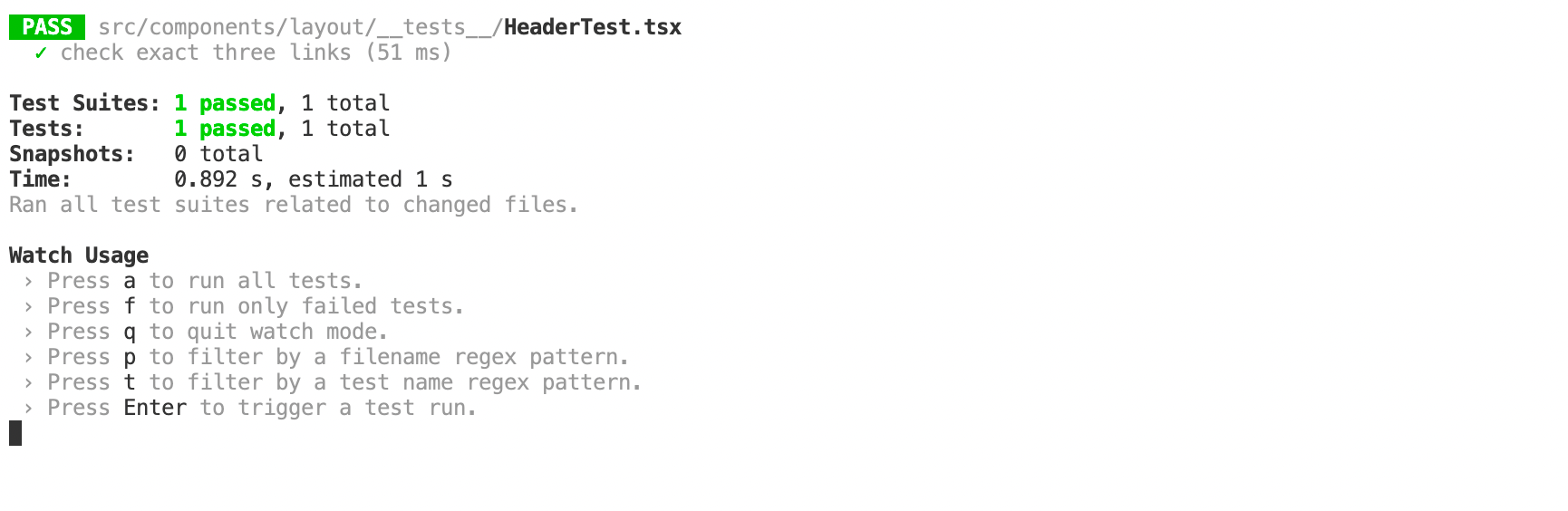
Ya tenemos nuestro primer test, vamos a añadir unos cuantos componentes más para aumentar el coverage de nuestro proyecto.
import React from 'react';
// eslint-disable-next-line import/no-extraneous-dependencies
import { render, screen } from '@testing-library/react';
import ProjectCard from '../ProjectCard';
import { Project } from '../../../model/project';
import { User } from '../../../model/user';
// eslint-disable-next-line import/no-extraneous-dependencies
import { describe, test, expect } from 'vitest';

const projectMock: Project = {
  _id: '8a9sdfasdf989fd',
  title: 'React',
  description:
    'React es el Framework web basado en componentes de Facebook. Cuenta con una curva de aprendizaje corta y mucha flexibilidad',
  version: '17.0.1',
  link: 'https://reactjs.org/docs/hello-world.html',
  tag: 'JavaScript, Typescript, React',
  timestamp: 765817712000
};

const userLogggedMock: User = {
  active: true,
  id: 'a8sfd9sf',
  email: 'johndoe@gmail.com'
};

const mockFeatured = 'FEATURED';

describe('ProjectCard', () => {

  test('renders title', () => {
    const { getByText } = render(
      <ProjectCard
        project={projectMock}
        user={undefined}
        closeButton={() => {}}
        updateButton={() => {}}
      />
    );
    expect(getByText(projectMock.title)).toBeInTheDocument();
  });

  test('renders description', () => {
    const { getByText } = render(
      <ProjectCard
        project={projectMock}
        user={undefined}
        closeButton={() => {}}
        updateButton={() => {}}
      />
    );
    expect(getByText(projectMock.description)).toBeInTheDocument();
  });

  test('renders version', () => {
    const { getByText } = render(
      <ProjectCard
        project={projectMock}
        user={undefined}
        closeButton={() => {}}
        updateButton={() => {}}
      />
    );
    expect(getByText(projectMock.version)).toBeInTheDocument();
  });

  test('renders', () => {
    const { getByText } = render(
      <ProjectCard
        project={projectMock}
        user={undefined}
        captionText={mockFeatured}
        closeButton={() => {}}
        updateButton={() => {}}
      />
    );
    expect(getByText(mockFeatured)).toBeInTheDocument();
  });

  test('Featured empty', () => {
    render(
      <ProjectCard
        project={projectMock}
        user={undefined}
        closeButton={() => {}}
        updateButton={() => {}}
      />
    );
    expect(screen.getByTestId('caption').textContent).toBe('');
  });

  test('User logged', () => {
    render(
      <ProjectCard
        project={projectMock}
        user={userLogggedMock}
        closeButton={() => {}}
        updateButton={() => {}}
      />
    );
    expect(screen.getByTestId('menuButton')).toBeInTheDocument();
  });

  test('Caption empty', () => {
    render(
      <ProjectCard
        project={projectMock}
        user={undefined}
        closeButton={() => {}}
        updateButton={() => {}}
      />
    );
    expect(screen.getByTestId('caption').textContent).toBe('');
  });

  test('External link', () => {
    render(
      <ProjectCard
        project={projectMock}
        user={undefined}
        closeButton={() => {}}
        updateButton={() => {}}
      />
    );
    expect(screen.getByRole('link')).toHaveAttribute('href', projectMock.link);
  });


});
Como podemos ver aquí tenemos un test más complejo, estamos haciendo uso de mockData para comprobar el estado del componente y hacemos uso de métodos como getByTestId para referenciar un elemento al que hayamos incluido el tag data-testid.
<CardCaption data-testid="caption">
    {props.captionText ? props.captionText : ""}
</CardCaption>
Tests Unitarios
Para los tests unitarios sí que vamos a hacer uso de Vitest, tanto para las aserciones en las respuestas de nuestro código como para mockear ciertos módulos, como por ejemplo toda nuestra API. La estructura es bastante clara, primero declaramos todos los elementos que queremos mockear, y declaramos nuestro ApiClient como un las funciones mock de vitest. Esto hará que cada vez que sea llamada por nuestro código, Vitest lo interceptará y podrá definir el valor de retorno que nosotros queramos.
Ahora solo tenemos que declarar los test suites, podremos al igual que con otras librerías invocar hooks para que se ejecuten antes o después de cada test, en nuestro caso lo haremos para limpiar el localstorage y eliminar todos los timers que tengamos. Una vez hecho eso, ejecutamos cada test y realizamos una aserción con el método expect.
/* eslint-disable @typescript-eslint/no-var-requires */
// eslint-disable-next-line import/no-extraneous-dependencies
import { beforeEach, expect, vi, describe, it } from "vitest";
import { getDefaultBaseUrl } from "./config";

describe("config testing", () => {
  let baseUrl = "";

  beforeEach(() => {
    vi.resetModules();
    delete import.meta.env.VITE_BASE_URI;
    delete import.meta.env.VITE_API_URI;
  });

  it("config with api base url from environment variable", () => {
    // Given
    const anyBaseUrl = "any-base-url";
    import.meta.env.VITE_BASE_URI = anyBaseUrl;

    // And
    baseUrl = getDefaultBaseUrl(
      import.meta.env.VITE_BASE_URI,
      import.meta.env.VITE_API_URI
    );

    // Then
    expect(baseUrl).toBe(anyBaseUrl);
  });

  it("config with api base url with another path", () => {
    // Given
    const anyBaseUrl = "any-base-url";
    import.meta.env.VITE_BASE_URI = anyBaseUrl;

    // And
    const extraPath = "/extraPath";
    import.meta.env.VITE_API_URI = extraPath;

    baseUrl = getDefaultBaseUrl(
      import.meta.env.VITE_BASE_URI,
      import.meta.env.VITE_API_URI
    );

    // Then
    expect(baseUrl).toBe(anyBaseUrl + extraPath);
  });

  it("config with no api base url", () => {
    baseUrl = getDefaultBaseUrl(
      import.meta.env.VITE_BASE_URI,
      import.meta.env.VITE_API_URI
    );

    // Then
    expect(baseUrl).toBe("");
  });
});

export {};
vi.mock('../api/api-client-factory');

const ANY_ACCESS_TOKEN =
  'eyJhbGciOiJIUzI1NiIsInR5cCI6IkpXVCJ9.eyJpZCI6IjYyMTJiNGRmYjUxODlmMzVlZGExZjBhOSIsImVtYWlsIjoibHVjYXNmZXJuYW5kZXphcmFnb25AZ21haWwuY29tIiwiaWF0IjoxNjQ1NDM2MTQ4LCJleHAiOjE2NDU0MzYyMDh9.HmqhMQIHMbTvCM-Ay46xTJAkazz84Ft8198t8AtwsuM';
const ANY_EXPIRES_IN = 80;
const CURRENT_TIMESTAMP = 1645436150000;
const ANY_EMAIL = 'lucasfernandezaragon@gmail.com';
const ANY_ID = '6212b4dfb5189f35eda1f0a9';
const ANY_USERNAME = 'lucasfernandezaragon@gmail.com';
const ANY_PASSWORD = 'any-password';
const USER_TOKEN = userKey;
// const ANY_USER_TOKEN: UserToken = {
//   id: ANY_ID,
//   email: ANY_EMAIL,
//   notBeforeTimestampInMillis: CURRENT_TIMESTAMP,
//   expirationTimestampInMillis: ANY_EXPIRES_IN * 1000 + CURRENT_TIMESTAMP,
// };

const ANY_USER: User = {
  active: true,
  id: ANY_ID,
  email: ANY_EMAIL
};

const ANY_TOKEN_RESPONSE: TokenResponse = {
  token: ANY_ACCESS_TOKEN
};

let setTimeoutSpy: any;

beforeEach(() => {
  vi.useFakeTimers();
  Date.now = vi.fn(() => CURRENT_TIMESTAMP);
  setTimeoutSpy = vi.spyOn(global, 'setTimeout');
});

afterEach(async () => {
  vi.clearAllTimers();
  vi.clearAllMocks();
  localStorage.removeItem(USER_TOKEN);
});

describe('login', () => {
  test('success - happy case', async () => {
    // Given
    vi.mocked(createApiClient, { partial: true }).mockReturnValue({
      token: vi.fn().mockResolvedValue(ANY_TOKEN_RESPONSE)
    });

    // When
    await login(ANY_USERNAME, ANY_PASSWORD);

    // Then
    expect(isUserActive()).toBeTruthy();
    expect(setTimeout).toHaveBeenCalledTimes(2);
    expect(getCurrentUser()).toEqual(ANY_USER);
  });

  test('success - then logs out when token expires', async () => {
    // Given
    vi.mocked(createApiClient, { partial: true }).mockReturnValue({
      token: vi.fn().mockResolvedValue(ANY_TOKEN_RESPONSE),
      logout: vi.fn().mockResolvedValue('')
    });

    // When
    await login(ANY_USERNAME, ANY_PASSWORD);

    // Then
    expect(isUserActive()).toBeTruthy();
    expect(setTimeoutSpy).toHaveBeenCalledTimes(2);
    expect(getCurrentUser()).toEqual(ANY_USER);

    // When (set the token to expire)
    vi.advanceTimersByTime(ANY_EXPIRES_IN * 1000);

    setLogoutIfExpiredHandler();

    // Then
    expect(isUserActive()).toBeFalsy();
  });

  test('failed - unauthorized', async () => {
    // Given
    vi.mocked(createApiClient, { partial: true }).mockReturnValue({
      token: vi.fn().mockRejectedValue(new Unauthorized()),
      logout: vi.fn().mockResolvedValue('')
    });

    // When
    try {
      await login(ANY_USERNAME, ANY_PASSWORD);
    } catch (e) {
      expect(e).toBeInstanceOf(WrongCredentialsException);
    }

    // Then
    expect(isUserActive()).toBeFalsy();
    expect(setTimeoutSpy).toHaveBeenCalledTimes(0);
  });

  test('failed - generic error', async () => {
    // Given
    vi.mocked(createApiClient, { partial: true }).mockReturnValue({
      token: vi.fn().mockRejectedValue(new GenericError(500, 'err')),
      logout: vi.fn().mockResolvedValue('')
    });

    // When
    try {
      await login(ANY_USERNAME, ANY_PASSWORD);
    } catch (e) {
      expect(e).toBeInstanceOf(Error);
    }

    // Then
    expect(isUserActive()).toBeFalsy();
    expect(setTimeoutSpy).toHaveBeenCalledTimes(0);
  });

  test('clear timeout', async () => {
    // Given
    const setClearTimeout = vi.spyOn(global, 'clearTimeout');

    vi.mocked(createApiClient, { partial: true }).mockReturnValue({
      logout: vi.fn().mockResolvedValue('')
    });

    setUserToken();

    // When
    await logout();

    // Then
    expect(isUserActive()).toBeFalsy();
    expect(setClearTimeout).toHaveBeenCalledTimes(1);
  });
});

describe('token', () => {
  test('init when token exists but it is expired', () => {
    // Given
    setUserToken();
    dateMakesTokenExpired();

    // Then
    expect(isUserActive()).toBeFalsy();
    expect(setTimeoutSpy).toHaveBeenCalledTimes(1);
  });

  test('getAccessToken without token set', () => {
    // When
    const actual = getCurrentUser();

    // Then
    expect(actual).toBeUndefined();
  });

  test('isTokenActive on non existing token', () => {
    // When
    const actual = isUserActive();

    // Then
    expect(actual).toBeFalsy();
  });
});

describe.each([
  ['current', true, CURRENT_TIMESTAMP],
  ['edge before expiration', true, CURRENT_TIMESTAMP + ANY_EXPIRES_IN * 1000 - 1],
  ['date before', false, CURRENT_TIMESTAMP - 1],
  ['exact expiration', false, CURRENT_TIMESTAMP + ANY_EXPIRES_IN * 1000]
])('isTokenActive', (desc, expected, testTimestamp) => {
  test(`is ${expected} on ${desc}`, () => {
    // Given
    Date.now = vi.fn(() => testTimestamp);

    // And
    setUserToken();

    // When
    const actual = isUserActive();

    // Then
    expect(actual).toBe(expected);
  });
});

interface UserToken {
  id: string;
  email: string;
  notBeforeTimestampInMillis: number;
  expirationTimestampInMillis: number;
}

function setUserToken() {
  const userToken: UserToken = {
    id: ANY_ID,
    email: ANY_EMAIL,
    notBeforeTimestampInMillis: CURRENT_TIMESTAMP,
    expirationTimestampInMillis: ANY_EXPIRES_IN * 1000 + CURRENT_TIMESTAMP
  };
  localStorage.setItem(USER_TOKEN, JSON.stringify(userToken));
}

function dateMakesTokenExpired() {
  Date.now = vi.fn(() => CURRENT_TIMESTAMP + ANY_EXPIRES_IN * 1000);
}
Test end to end
Vamos a realizar una primera versión de los test end to end con la herramienta playwright.
Lo primero que haremos es añadir la configuración a nuestro proyecto
import { defineConfig, devices } from '@playwright/test';


export default defineConfig({
  timeout: 5000,
  testDir: 'src/__tests__',
  //testMatch: ['/e2e/**/*.spec.ts'],
  /* Reporter to use. See https://playwright.dev/docs/test-reporters */
  reporter: 'html',
  /* Configure projects for major browsers */
  projects: [
    {
      name: 'chromium',
      use: { ...devices['Desktop Chrome'] },
    },

  ],

  webServer:  {
        command: 'cd ../api && npm run dev',
        port: 4000
    }
});
Y ahora en la ruta __tests__/e2e crearemos un fichero con la siguiente estructura:
import { test, expect, Page } from '@playwright/test';

const cleanTestProject = async (page: Page) => {
  await page.goto('/');
};

test.beforeEach(async ({ page }) => await cleanTestProject(page));
test.afterEach(async ({ page }) => await cleanTestProject(page));

test('Landing page', async ({ page }) => {
  await page.goto('');

  // Test that the header is visible
  expect(await page.getByText('Error creating project')).toBeTruthy();
});
Que automatizará el flujo de usuario con la aplicación y comprobará que todo funciona correctamente.